
The Ghosts of Hops
Peopled work

If you spend long enough in a place, and you pay enough attention, especially as place as old as this, you might get the feeling that you’re living among ghosts. I first got that feeling a few years ago, and I haven’t been able to shake it since. You may never see them, or rather they may not show themselves to you. But they’re still there: they’re always still there, you just need to know how to look. They have a habit of sticking around.
Me, personally, I live among the ghosts of hops. Those little cones, dearly prized by brewers, the aromatic flowers of the hop plant. Hops are used to make beer, used as a preservative and flavouring: they give beer that distinctively beery taste, that beery smell and bitterness, that essence of beer.
12 o’clock at night we used to wait at London bridge station, wait for the train to come in. and if you didn’t have enough money to pay for the kiddies, you’d bung em under the seat. “Go on get under there, before he comes round!”
And so, with our inexhaustible love of the warm fuzzy glow of booze, we’ve been growing them for years. Hops have been grown in this corner of the world for hundreds of years, at least as far back as the 17th century. There are only two regions in the whole of the UK that can grow hops, or at least grow them with any success: Kent/East Sussex and Herefordshire/Worcestershire, separated by at least 7 counties, and nearly 200 miles. Both have the right microclimate, and soil type, and rain fall, and whatever else, in a particular combination not possessed by any of the intervening counties, necessary to grow those precious cones.
Hops are difficult bastards to grow. Even in the good old days, before the ghosts, they were hard work. They’re climbing plants, they can’t hold their own weight, a lead shoot that wants to wrap around a support. In the wild, they climb over shrubs and through forgotten hedgerows, up old telegraph poles and drain pipes.
And the beds were made of straw, and we were comfortable! And it was beautiful!
To grow them for beer, you have to build them a scaffold to climb: poles 15ft tall, held upright with a grid of metal wire, from which are strung the string that the hops will climb. They’re planted by hand, female plants only, transplanted one plants to one string. In this part of the world, this intricate structure is a hop garden – in the depths of darkest Herefordshire, it’s a hop yard.
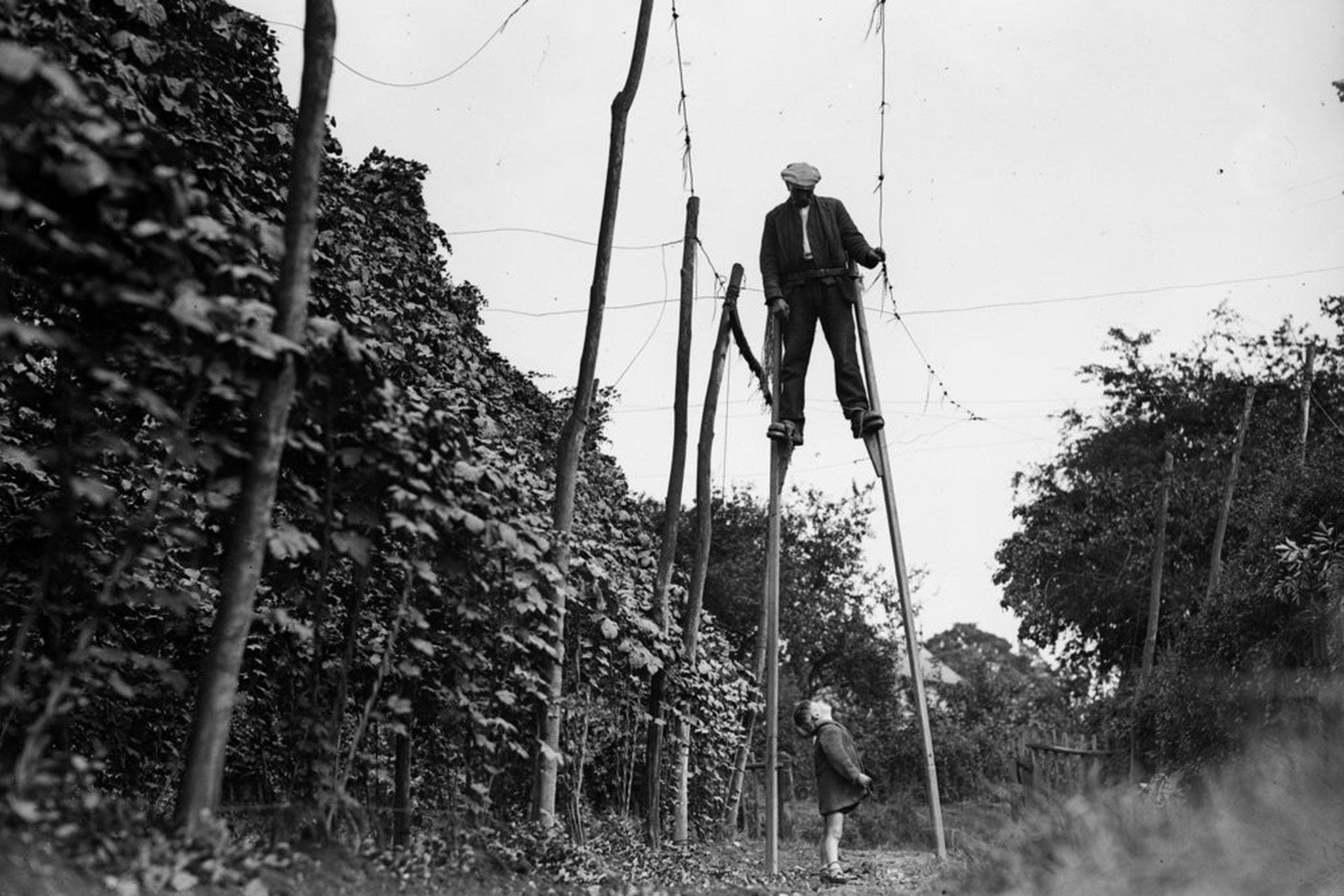
They have to be trained, softly encouraged, to climb up the string. All by hand. The lead shoot has to be wrapped around the string, clockwise. If they’re wrapped anti-clockwise, they’ll fall off half way through the season. With luck, the plant will climb up the string, loop around it, and in summer it will flower. To harvest, they’re cut at the base, pulled down from the scaffold, and the cones are separated from the rest of the plant.
It was just like a little community, all like “where’d you come from?” “oh, Bermondsey”, “where’d you come from?” “oh, Elephant and Castle”, “where’d you come from?” “oh, Old Kent Road”, it was just like that all the time, and we met like that every year.
Most of the work, so I’m told, happens after the harvest. Hops have to be dried, brought down to a moisture content of 8%, from somewhere near 80% in the field. Hops are, or were, dried in oast houses, buildings designed especially for the process. Two stories of solid brick wall, leading upwards to a steeply pointed roof. A building-sized kiln. At the apex of the roof is open, a ventilation hole, to let the smoke out. Hops are dried with a fire burning at the base of these oast houses. The hops are stored in multiple layers above the fire, trellised, suspended over the heat. And the heat is what gets them down to 8% moisture.
To funnel the smoke out, and to stop the rain coming in, the hole in the roof is covered with a cowl: a triangular prism sort of structure, with an empty face; it rotates in the wind, always with its back to the wind, and the wind sucks out the smoke.
And outside the pub on a Saturday night or a Sunday morning was just like a fare ground. Carts, all the carts, horses, and gypsies, everyone, we all mixed, we was all one.
This is the distilled form, the essence, of the oast house. But, in the absence of the homogenising force of absentee architects, there is wild variation on the theme. Most in this part of the world are round-based: imagine a beer can with an upside-down ice-cream cone for a roof. Over in Herefordshire, most are square-based: imagine a cube, with a roof shaped like the Louvre stuck on top.
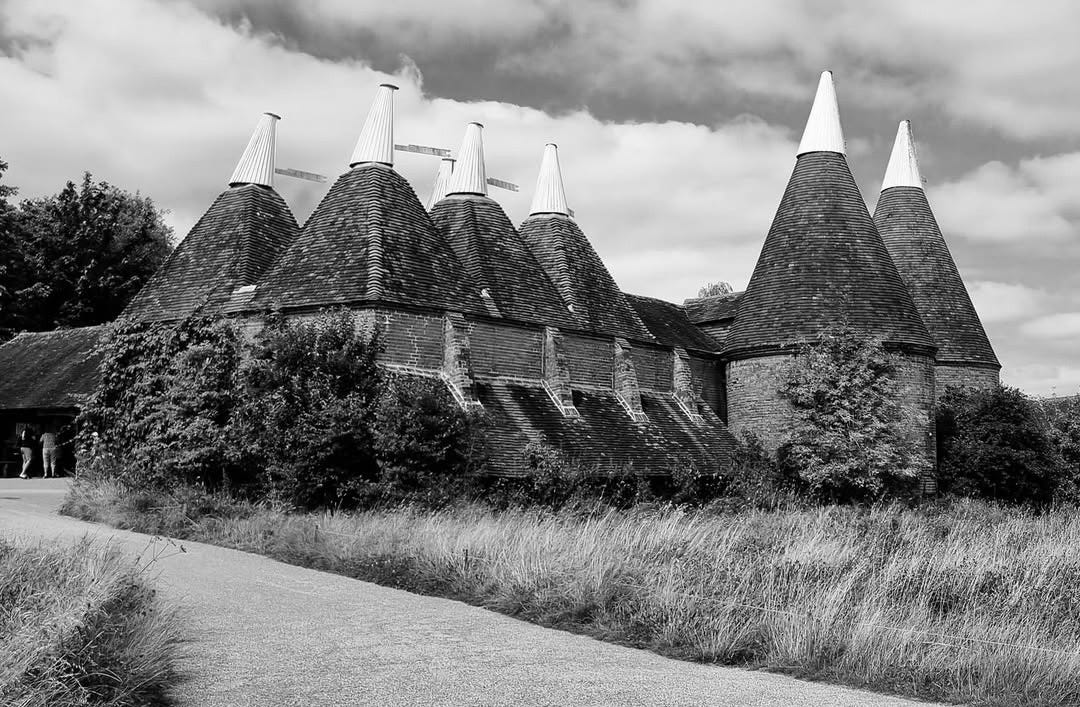
Before the ghosts started appearing, there was good money in hops. At its peak, the money from hops would pay for the cost of the land within two years of growing. Today that figure floats somewhere near 80 years, if you’re lucky. There was good money in hops, and these oast houses were cheap to put up, and they’re everywhere. There’s one every half mile or so, engulfed by and lost within a new housing estate, sitting at what was the centre of the old hop garden. Walk through this part of the world, and you get a feel for how big, or small, farms used to be: each oast house was another farm, another family.
We start with Nel saying “we aint got our hopping letter yet, wonder when we’re gonna get it”, all of a sudden postman come, he’ll deliver a letter, find out where Nel is, “yea alright Nel it’s here”, and she’d be well pleased, she’d be all “get ready, get the boxes ready, make sure the wheels are greased”, all like that. Nel go round to Ma’s, saying “I got mine, have you got yours yet” “no I aint got mine yet, wonder if they’re gonna bar me this year, wonder what I did wrong last year” all this reaction like, then of course next post, Ma will get her letter “I got my letter! Come and give us a hand, what time you going in the morning?”
Anything that sticks around in a place for long enough starts to change that place. These changes are normally small and subtle, but they accrete and compound. And the longer that that thing sticks around, and the more noise that it makes, the bigger the changes are, the more that it bends that place towards its own needs. The feel of a place, of any place, is the accumulation of all of the needs and noises of all those that call that place home. At its best, this is a delicate dance of mutual striving and aspiring, no one voice dominates, the richness of a place is the richness of all those that sing to it, all those that demand something of it, and give something in return. We’ve been dancing this dance for years, ploughing fields and building villages, singing songs to orchards – we have become louder and more dominating, less able to listen, since we unearthed the combustion engine. But we’re not the only ones capable of dancing this dance, of changing a place towards our needs.
Hops do it too, change a place towards its needs. Most obviously it’s the oast houses: hops need drying, and so the oast houses are built in their name. They’re everywhere. These are the remains of the hops striving to be heard, striving and aspiring. But the full extent of the scattered debris of the dance are buried deeper still.
The woman in the bin next to us, a regular old-fashioned East Ender, kept her grandchildren at it like slaves – “Go on Rose, you lazy little cat, pick them ‘ops up. I’ll warm your arse if I get up to you”.
One example is the hop anchors, scattered in old ditches and hedges. These are the metal stakes that held the scaffolding in place for the hops to climb. You trip over them all the time, lost in forgotten places, not exactly wild, but far from tame. Hops were grown here? In this old woodland, in this dank ditch? Another is the hop pockets, hung on pub walls. These are the old hessian sacks, heavy canvas bags, that would take the hops from the oast houses to the brewery. Every farm had their own, with its name and badge proudly stamped on the front.
You knew you had beer there. The good old stock ale. Pints of that, no half pints, pints! With a shilling on your glass in case you nicked it. And the kids used to come round, and they used to watch. Anyone put their glass down cor blimey when you looked round the next minute it was gone, they’d run in the pub and change it for the shilling. That’s the truth!
But the hardest to spot is that which looks at you straight in the face, hidden in plain sight. Towards the late 1800s, with the industrial fervour at its zenith, trains lines sprung up all over the country. In this corner of England, the Garden of England, their initial justification was commercial: to bring the labourers down from, and the food up to, the capital of London. The principal train line from London to Ashford, and from Ashford to Canterbury was built on hops: the ancient pilgrimages, the stuff of Chaucer’s tales, opened up by the iron horse to the songs of the climbing plant.
My hometown, Paddock Wood, literally wouldn’t exist without hops. Initially, it was just a railway siding, equidistant between the market towns of Tonbridge and Marden, nothing more than a place for the trains to stop to let the hop pickers off. Before the train came along, there was no town. But slowly it grew, dancing to the tune of hops. A pub and a hotel on the old station road, then a church and some workers’ cottages.
It’s only going down hopping that worries us, cuz we can’t have holiday now, I never go nowhere for holiday, I can’t afford holiday. No hopping was our holiday, cuz we knew we were gonna earn a few shillings to spend.
And this main London line grew side branches, unfurling onto the countryside, built to bring more Londoners down to hop gardens. Some of these side tracks still exist, some have died. Scattered in their wake are the bridges, railways crossings, old station platforms, stuck singing the half-remembered tune of hops. Strangest of all are the bridges over nothing, the bridges that cross where the track once was. There are only a few of these nothing bridges that still exist. And if you look closely from the top of them, you can see the curve of the old railways imprinted on the landscape. Ghosts have a habit of sticking around.
From the last weeks of August, up until the middle of October, this part of the world was filled with poor Londoners, down to Kent on their working holidays, down hopping. The hops were first – harvest lasted a little over a month. They needed the most hands. Once hops were done, a few stuck around for the fruit, the picking of apples and pears.
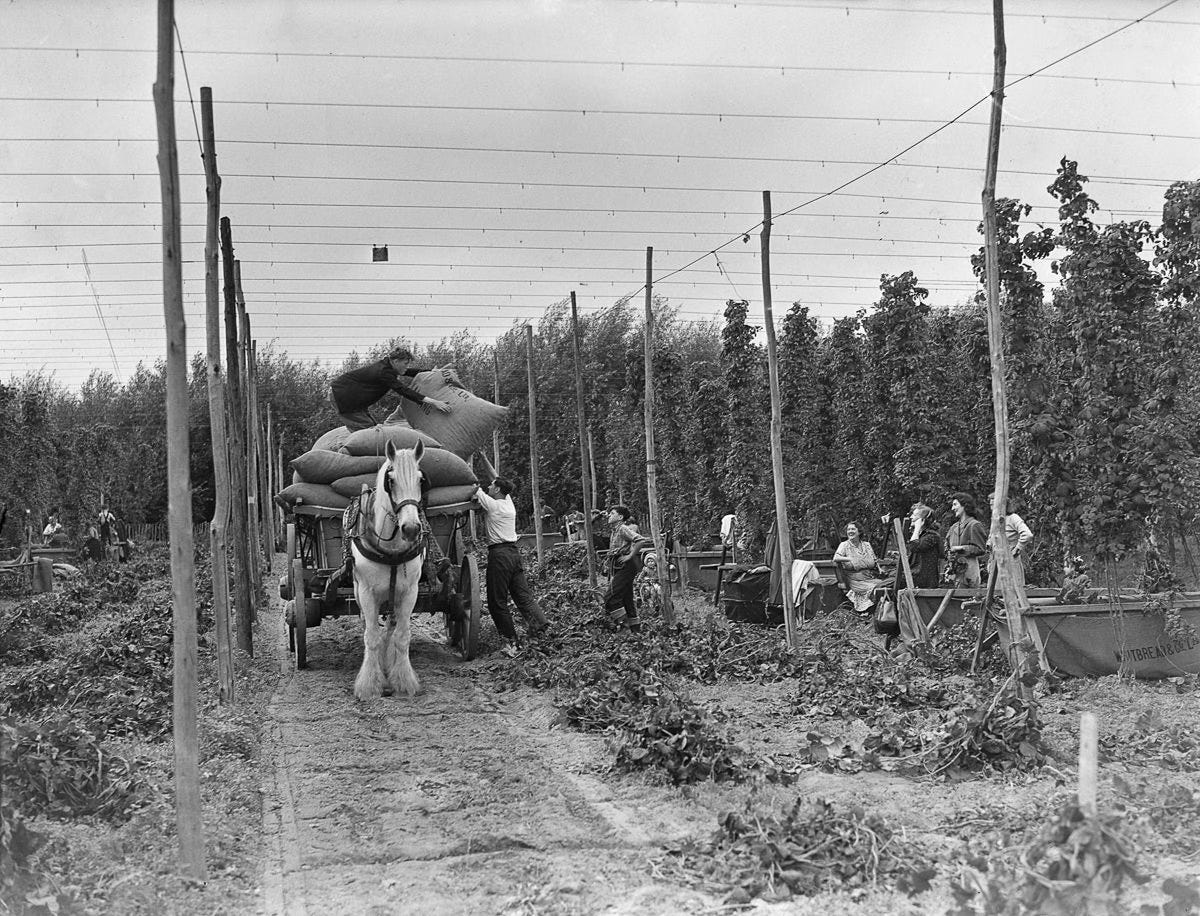
Everything worked around that hop box. You start getting it together around July, buying bits and pieces, tins of food, everything you could put away. We didn’t have the money to buy our food when we were down in Kent. And it used to be “don’t you dare touch that, that’s for hopping”, and God help you if you did happen to take anything out. And it was clothes and boots and everything really, everything that you’d need to take for 6 weeks.
They would come down on dedicated hop picker train services. Entire families, multiple generations. A letter would come on the post, inviting the family down for another season. Train ticket enclosed, details of exactly which farm they’d be on, which hut would be theirs. Everything they’d need for the season – food, and bedding, and curtains, and pots and pans, and, if there was space, a change of clothes – their whole lives put into a hopping box, taken on the train down to Kent. And these hopper huts were nothing more than a corrugated metal shed, one hut per family, one room for everything. Some painted the inside, put up shelves and wallpaper, something to make it feel like home. They slept on a bed of sticks and straw, seriously.
George Orwell, that brilliant writer of the rural and urban poor, spent some time in Kent, down hopping. ‘As to the living accommodation… what can it have been like in the old days is hard to imagine, even now the average hop pickers hut is worse than a stable. My friend and I with two others slept in a tin hut ten feet across with two unglazed windows and half a dozen other apertures…. and no furniture save a heap of straw… What keeps the business going is probably the fact that the Cockneys rather enjoy the trip to the country, in spite of the bad pay and in spite of the discomfort.’1
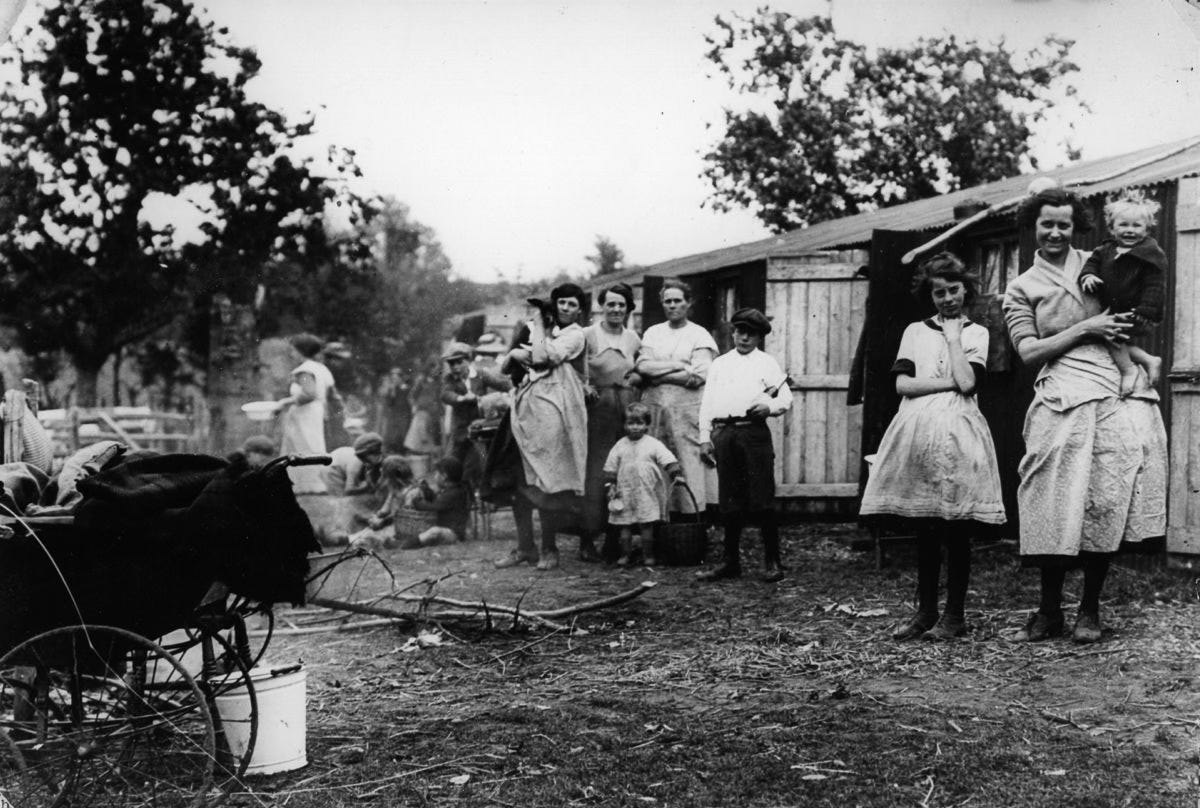
There’s an old lean-to shed on the farm at home, made in part of salvaged corrugated metal sheets. This shed was built when my grandfather first came to the farm, and it was put together without much money. The metal sheets came from all over the place, from wherever he could find. Some of them came from old hopper huts. Haunting and beautiful, there’s one sheet that was hand painted by one of the pickers. Tiny and intricate flowers, each slightly different from the rest, painted to make the hopper huts a beautiful place to live for the month that they called it home.
You’d make your bed up with sticks, when the farmer brought them to you, they were all in bundles, called faggots. Well you’d lay these all out as flat as you could, so they’re no pieces sticking up and then on top of those you’d lay a thick layer of straw, and that was your bed.
There are stories of pubs that only opened during the hopping season. One pub, so the story goes, was nothing more than a hatch in the wall, where you’d yell your order, and out would come a pair of pint-bearing hands. This pub did well enough in that one month that the owners didn’t have to work for the rest of the year. So the story goes.
But I could go on like the forever, with old stories from an era that has died. I won’t. That era did die. That era is now dead.
During the second World War, hop gardens were turned over to potatoes, dug for Britain. When the land was put back into hops, a soil-borne fungal disease moved from the potatoes to the hops. Verticillium wilt. In this corner of the world, it’s not just a nuisance with a yield penalty, it’s fatal. To this day, there is no cure. If that land carries the disease, the only thing to do is to pull out all of the hops, burn the scaffold, burn the dead hop plants, and grow grass for seven years, in the hope that the wilt dies for lack of a host. A cathartic cleanse the soul of the soils.
All of this was happening in the age of forward-looking agricultural policies. Mechanisation and global trade were the silver pullet to all agricultural problems. Less hop pickers were needed, as machines did more of the work. A family of five could be replaced by a machine and a labourer of one, if the machines were kind enough to share. Pubs start shutting, so do hotels, and the side tracks of rural train lines. Gone are the days of hatched pint-bearing hands paying for the year.
Simultaneously, the market is flooded by imports. First Germany, then the USA, and finally New Zealand. There is a tiny band of climates suitable to hop growing. But that tiny band is now willing and able to compete globally – at a free and fair market price, of course. The small hop gardens of Kent – two acres here, and ten acres there – can’t compete, not against the thousand acre hop farms of the USA. As was the case across all of agriculture, the new songs were sung by machines: small fields are made bigger for their needs. And as the ecosystem is simplified, disease pressure mounts.
This decimating fungal disease never made it out of this island, not to the same extent. It exists in Germany and the USA, granted, but it is milder: a yield burden, not a fatal condemnation. It never made it to New Zealand. To this day, hop farms there are a bio-secure zone. If you want to wander around, they give you clean clothes, a fresh pair of shoes, especially if you’re involved in UK hops.
Apparently, there are only two organic hop producers left in the whole country; one of them is Paul McCartney, or Cliff Richards, or someone like that. Those that survive in the conventional system, those that cling on, are spraying their hops once every two days in peak season. Fungicides, and herbicides, and insecticides, and every imaginable poison of agrochemistry to try to prevent this plant that just wants to die from dying. And the last kick in the teeth is climate change. As that starts to accelerate, with wetter and milder winters, contrasted to hotter and drier summers, things become much worse for the hop grower.
From its peak in the 1880s, the total UK hop growing area has fallen from 77,000 acres to its current figure of less than 2,000 acres. There are a little over fifty hop farmers left in the whole country2. All of the hop growers in the country could fit on one bus. I live in the heart of what was hop country, and I don’t know a single commercial grower. The most I can give you is one farmer who grows them ornamentally for gastropubs. An era that has died, an era that did die, an era that is dead. And we are haunted by its ghosts.
The oast house and the train line. Those which exist only because hops so successfully changed the place towards its needs: hops needed pickers, and hops needed drying. And so the landscape was bent towards its needs. But how does the landscape respond when the lead drummer dies? What fills the silence without the tune of hops? Well, in this time, and in this age, it’s money. Of course.
Oast houses are converted, first to farm cottages, then to commuter homes. With a delicious hint of irony, the trainline, which was built to bring poor Londoners down to the countryside, now serves to bring rich commuters up to London, commuters living in their beautifully converted oast houses. Filled with character and rural charm, only an hour to London Bridge, two-and-a-half million quid.
And what is it like to live amongst this? A rural economy undermined by global trade and mechanisation, then gutted by new money. What is it like to live in a place whose work is elsewhere, whose work is found on the London end of the line? It’s all tremendously slick efficient, to work in the city and to be funnelled back to the country every evening, to be fed by supermarkets, with fancy foreign foods from afar, in towns surrounded by arable deserts and the commuter’s oast houses. But what is it actually like to live here? What remains?
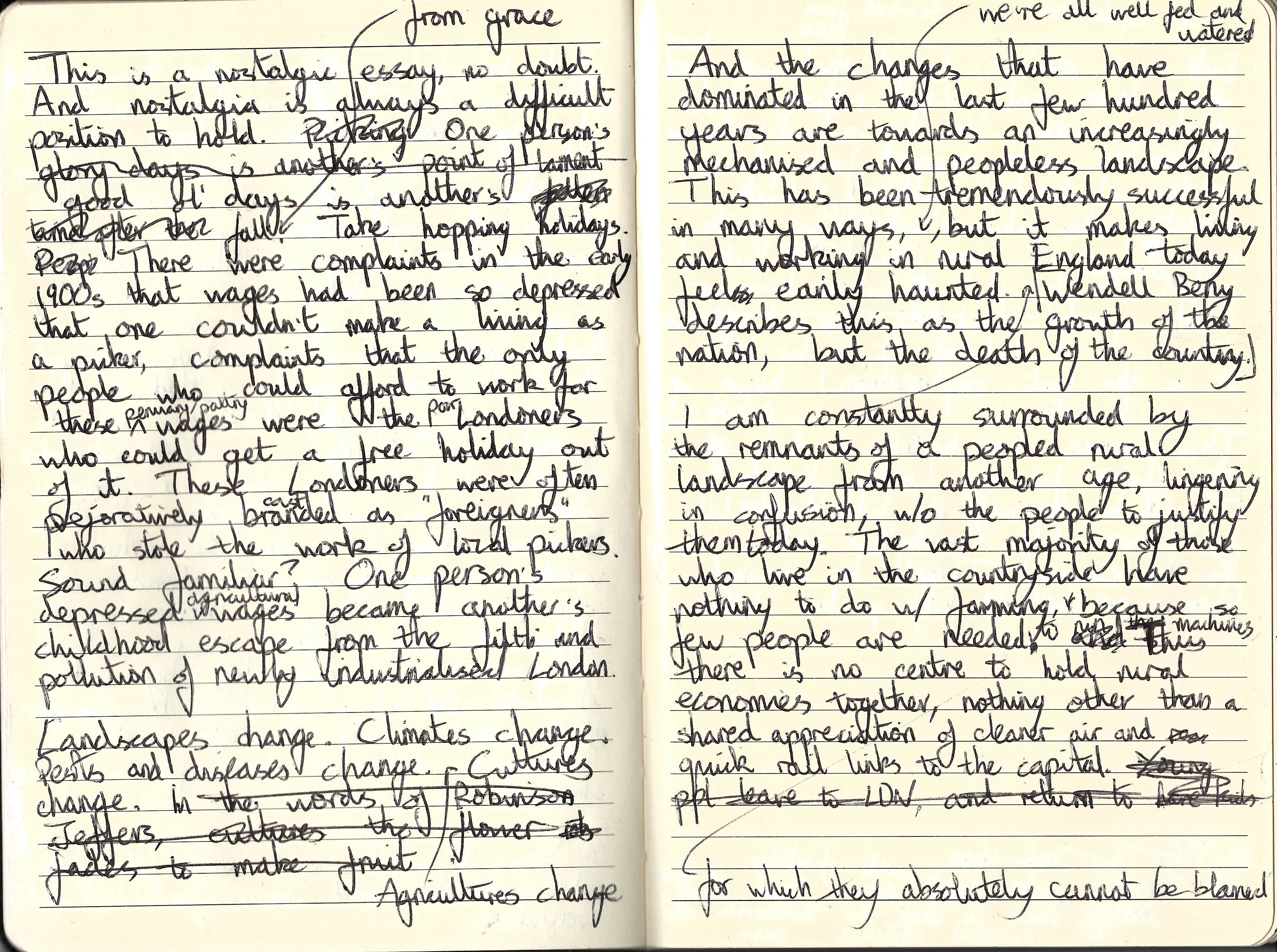
This is a nostalgic essay, no doubt. And nostalgia is always a difficult position to hold. One person’s good ol’ days is another’s fall from grace. Take hopping holidays. There were complaints in the early 1900s that wages had been so depressed that one couldn’t make a living as a picker, complaints that the only people who could afford to work for the paltry wages were the poor Londoners who could get a free holiday out of it. These Londoners were often pejoratively cast as “foreigners” who stole the work of local pickers. Sound familiar? One person’s depressed agricultural wages became another’s childhood escape from the filth and pollution of newly industrialised London.
Landscapes change. Climates change. Pests and diseases change. Agricultures change. Cultures change. And the changes that have dominated in the last few hundred years are towards an increasingly mechanised and peopleless landscape. This has been tremendously successful in many ways — we are all well fed and watered — but it makes living and working in rural England toady feel eerily haunted.
I am constantly surrounded by the remnants of a peopled rural landscape from another age, lingering in confusion, without the people today to justify this debris. The vast majority of those who live in the countryside have nothing to do with farming, for which they absolutely cannot be blamed, because so few people are needed to run the machines. Thus, there is no centre to hold rural economies together, nothing other than a shared appreciation of cleaner air and quick rail links to the capital.
Wendell Berry describes this as the growth of the nation at the expense of the country. And we mustn’t forget that we live our lives not in the nation, but in the country. In the actual landscape. Abstracted work, severed from place, creates abstracted cultures, severed from place, which creates the nihilism and hopelessness and the political anger of the age. I can’t prove this of course, not with any mathematical certainty, but I believe it to be true. It is the best explanation I have. Good work is worth infinitely more than income, which is what the technocrats and national statisticians must obfuscate to continue this game.
This summer, I’m hosting a day on the farm for my London friends. They’ll be rogueing the fields, picking out weeds. In the evening, I’ll feed and water them with a barbeque and a piss up. They’ll be coming down to Kent on the old hop picker line.
https://orwellsociety.com/orwell-and-other-writers-on-hop-picking-by-ron-bateman/
https://innovativefarmers.org/news/farmers-collaborate-to-find-hop-varieties-for-a-growing-sustainably-produced-beer-market/
All of the quotes from the hop pickers are taken from this amazing video. It’s really worth watching.
Photos are taken from various sources, including:
https://favershamlife.org/hopping-kent/
https://flashbak.com/picking-hops-in-kent-1900-1949-415583/